NetApp EVO:RAIL

EVO:RAIL LogoFor those not familiar with EVO:RAIL, this is a great solution from VMware that offers a hyperconverged infrastructure with easy management by leveraging software solutions such as vSphere, vCenter, VSAN and log insight. This solution seems to have the attention of many customers as deployment, and administration are greatly simplified and does not require a high level engineer to maintain the environment.

Although the announcement that NetApp would be launching a hyperconverged EVO:RAIL solution was made late last year, the product has not yet been released to the public (as far as I know). So there are a lot of questions out there. Is it FAS? Is it EVO:RAIL? or a combination? Well, the answer is both and more.

This is a NetApp integrated EVO:RAIL solution that includes both EVO and the NetApp C-DOT we currently know. This offering allows low level admins to administer VMware and NetApp from the same console via VSC. More on VSC, VASA and VAAI here. So in essence, when you get the NetApp 4RU appliance, you use a simple GUI wizard that automatically configures NetApp C-DOT and presents the storage to VMware. So this solution not only virtualizes the compute side but also the storage side.

Being that you have NetApp integrated into this solution, you are still able to use different protocols as well as SAN and NAS offerings, just like we do now with other FAS systems. This solution also includes automated back-up and recovery features, QoS, and Cloud integration by leveraging NetApp Data Fabric.


NetApp EVO:RAIL
NetApp EVO:RAIL

So, Why did NetApp decide to jump on the EVO:RAIL bandwagon???

Well, I believe that NetApp recognizes the competition with new storage vendors such as SolidFire, Tintri, and Simplivity among others, that offer all flash, high performance, easy to use hyperconverged solutions. Also NetApp recognizes the need for a solution for small and medium size businesses that do not have the luxury of hiring several IT staff to manage different areas of IT. Lastly, I believe NetApp is recognizing that in order to survive, they need diversify, as the days of shared enterprise storage may be coming to an end by the introduction of new technologies that drive costs down and simplifies administration while reducing overhead.


Uses Cases:

NetApp seems to be targeting departments and business areas for this specific solution. In my opinion EVO:RAIL (not just NetApp’s) has many other uses cases such as VDI deployments, production loads for remote offices in different geo-locations, test/dev, as well as DR source/target when combined with a Cloud offering.

I’m curious to see what the final product would be like, and how it would stand against other EVO:RAIL offerings.

 

TIPS: Explain the Cloud to your Boss

littlecloud.svg

I am calling this article “TIPS” hoping it serves a dual purpose. On one instance, it should help you understand what the cloud is from a high level view if you are still fuzzy about the subject, but it will also remind you of the Techniques to Inform, Present and Show (TIPS) details about the cloud.

I recently completed my Masters degree in Cyber Security, and just so happened that I did my research paper (Thesis) on the cloud. I thought this would be an easy topic since I knew everything about cloud computing, so I thought. As I dug deeper, I found interesting aspects, vulnerabilities, compliance advantages and disadvantages, but also some use cases where the cloud was a perfect fit, and some where it did not.

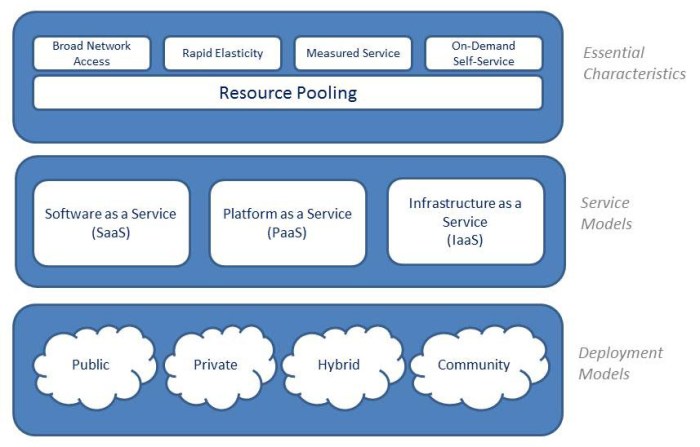
So, the cloud is not a new concept, as it has been around for quite some time. Cloud computing is the convergence of resources that allows for a centralized location of shared resources that can be deployed quickly as needed. This methodology has been in place for many years. What has changed is the location, availability, accessibility and pricing, which is what executives care the most about in most instances. There are 4 types of cloud, also known as Deployment Models:

  • Private – On Premise
  • Public – Hosted by a service provider
  • Hybrid – Combination of Public/Private
  • Community – Cloud composed of organizations in the same field or common interests that drives a requirement. For example, a group of hospitals the require a cloud service provider to be HIPAA compliant.

cloudtypes

Aside from the Deployment Models of Cloud Computing, we also have service models. Although you may have heard many, many service models being offered, there are three official service models where different services may fall into. So, a vendor’s marketing strategies that create their own service models, is only causing confusion to potential users as well as delaying the adoption of the technology. There are three service models plus the highly utilized on premise option.

  • Private – On premise. All service models are available within a company’s data-center.
  • Software as a Service (SaaS) – Offers only software available through the internet. Think of it as your iTunes, or GMAIL.
  • Platform as a Service (PaaS) – Offers a platform where customer can develop, and run web applications without having to worry about servers, network, etc.
  • Infrastructure as a Service (IaaS) – This offering provides everything but the kitchen sink. It may include compute, storage, networking, management, security, hypervisors, etc.

cloudmodels


From a high level view. This is what the cloud is about. The term has gained interest in the last several years thanks to the advances in technology, and communications which allows for fast, scalable, and cost effective solutions to the business. Before you jump on the cloud band wagon, you should do your due diligence and investigate the pros and cons of cloud computing, especially as it relates to compliance, and security. I won’t go there, I promise.

To wrap things up, remember to follow TIPS. Use the Techniques such as the need to Inform yourself before you tell others, Present accurate information in a simplistic way, and Show the pros and cons of the solution, as well as a high level logical design highlighting the differences between the different offerings.

cloud-overview

Image source: rividium.com

vExpert: So What the Fuss

vExpert

“So What the Fuss” is not just a Stevie Wonder song, it is also what many people are thinking about the vExpert announcement. This past Thursday, VMware announced the selected vExperts for 2015.

What is vExpert?

Let’s start with what is not. A lot of people think of it as the highest cert available from VMware, and confuse it with the VCDX certification. Well, it is not. Although some VCDXs are vExperts, not all vExperts are VCDXs. A vExpert is an individual that is passionate about his/her job and cares enough to share knowledge with others without compensation. People become a vExpert based on their quantitative and qualitative contribution to the community, not by taking a test; therefore, vExpert is not a certification.

What’s in it for me?

This program not only helps VMware get the word out about their products, but it also helps aspiring vExperts push the limits and dig down into the technology and capabilities. This not only benefits the individual’s knowledge base, but also his/her employer. For those of us that are customers, the employers win by having the best infrastructure they can have. For vendors/consultants, it makes their jobs easier. For start-ups, well, this should be required, IMHO.

So What the Fuss?

So, what is the big deal? Well, it is a big deal in my opinion. Individuals spent countless hours of their personal time, including nights, weekends, and being away from family in order to contribute to the community. So, to be recognized by VMware, is a nice pat on the back for those of us that make the sacrifice. VMware has a great community and a great program led by Corey Romero and his team, so thanks to them for the all the great work they do. I am humbled and honored to be named a vExpert once again.

vSphere 6 Availability Enhancements

With the introduction of vSphere 6, many new enhancements have been introduced. Given that IT is primarily delivered as a service within a business, the availability of our environment is often high priority. This new version of vSphere introduces the following enhancements:

  • Better vMotion Capabilities
  • Multi-Processor Fault Tolerance (FT) (up to 4 vCPUs)
  • App HA now supports more applications
  • vSphere Replication has better RPO (15 minutes) and scalability (2000 VMs)

There are other availability enhancements in vSphere 6, but the previous list really called my attention. Specifically the vMotion capabilities. In previous versions, moving VMs between vCenters was a little cumbersome and required a lot of manual intervention such as scripts or even down time. Such capability is now possible with vSphere where VMs can be moved not only across datacenters, but also across long distances (greater than 100ms round trip time. It is now possible to perform vMotion tasks across virtual switches. However, it is important to understand that the vCenters have to be part of the same SSO domain for this to work.

What does all this mean to me? Well, in my opinion, these enhancements can be extremely handy for disaster prevention exercises. Take a scenario where there is an advanced notice about a hurricane, or flood. Let’s assume that that a stretched VLAN or VXLAN has been configured across 2 data centers with a reasonable rtt (about 100 ms or less). In this case, the option exists to move some powered-on VMs to another vCenter within the same subnet in order to prevent down time for the business. Of course, this can also be accomplished by SRM if already implemented.

These enhancements as well as the ones in the network, managements, and storage realms makes vSphere 6 impossible to ignore, and set VMware apart from its competitors.

vSphere 6 Web Client: Yes, Let’s go there…

Since the introduction of vSphere 5.1, VMware introduced the new Web Client. Yes, there was another web client out there, but it was not widely used. A lot of people questioned the change towards a web interface, so here are many reasons for the Web Client:

  • Access from any device with Web access
  • No need to install binaries in multiple locations to access the vSphere environment
  • Multi OS friendly
  • Scalable solution
  • API friendly

This first version was well received by many, but others noticed some slow response within the browsers. Well, I am happy to say that the new Web Client in vSphere is anything but slow. I know for a fact that the VMware team has spent countless hours working to get the slow response issue resolved. I was privileged to be part of a private customer Alpha test for vSphere x.y , and the difference made since the Alpha up until Beta 2 has been tremendous. I had the chance to voice concerns in many areas and obviously the Web Client was one of them, and let me tell you, VMware listens very well and does whatever needs to be done to make customers happy.

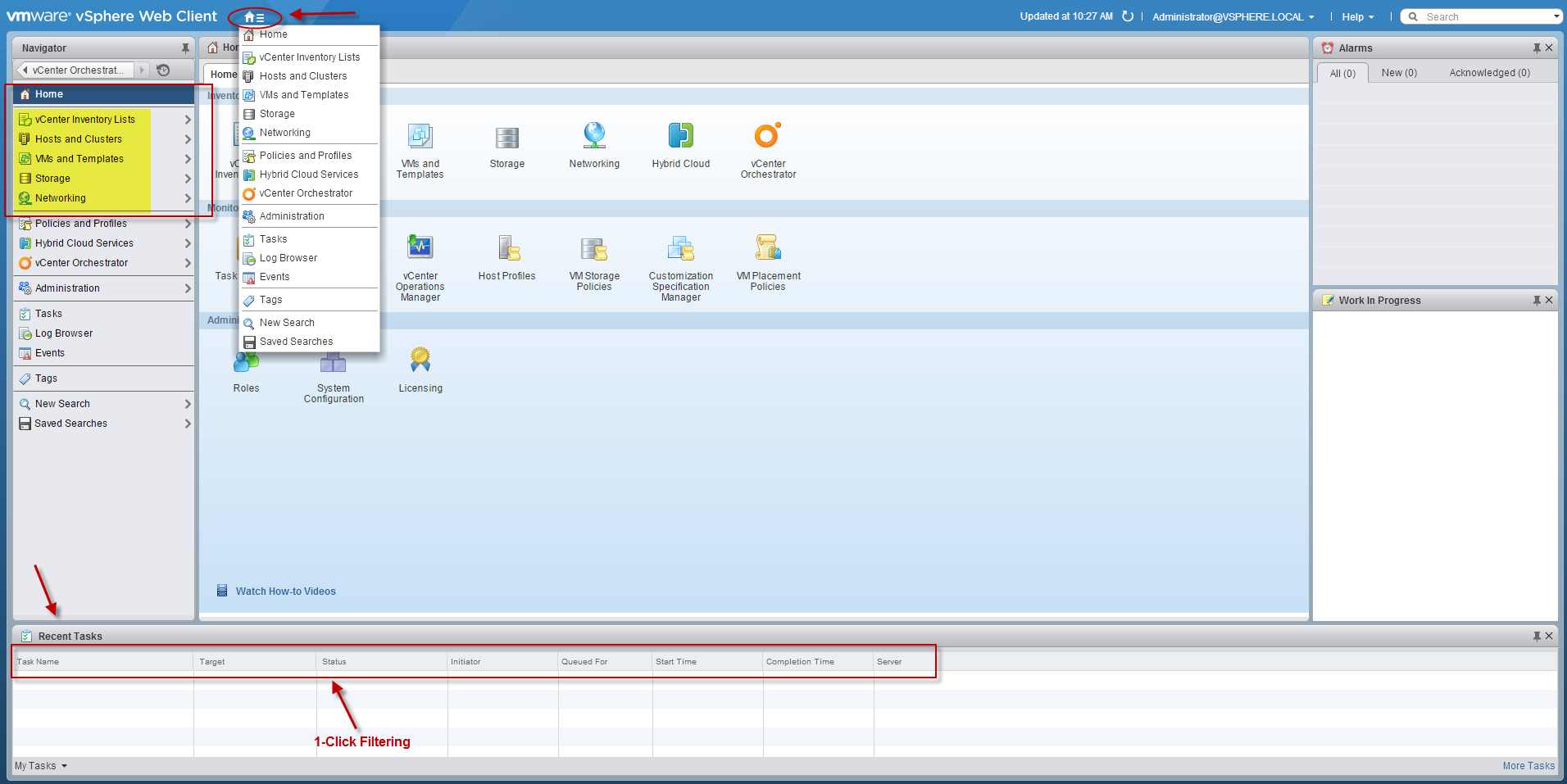
I will list some of the changes to the Web Client that I believe most customers will REALLY like.

  • Fast response times for Web Client interaction
    • Very noticeable
  • Faster log on process
  • Browser Friendly
    • Previous version had best results using Google Chrome
  • Recent Tasks (at bottom) is back
  • Drop down menu from home icon for easy, 1-click navigation
  • Core items added to left pane (Networking, Storage, VMs, Hosts)
  • vCenter Inventory Lists
  • 1-click task filtering


These are some of many improvements in the new vSphere release that will satisfy the requests of many customers. I was extremely impressed about the speed of the Web Client, but the additional features are icing on the cake.

As you may infer, the “fat client” will play a small to non-existent role moving forward. The C# client may still be used to access the individual hosts, as well as having read only capabilities for objects with virtual hardware version 9 and above, but vCenter tasks will be have to be done through the new an improved Web Client. Based on the huge improvements and new features, I don’t think many people will miss the old client.

Web_Client