NetApp VSC, VASA, VAAI for VMware vSphere: Why do I need this?

In most software meetings, round tables, and customer reviews and councils I have been part of, the feedback has been about a common topic the majority of the time. Customers want to have a single location/interface to manage multiple products. Fortunately, some aspects of NetApp storage can be managed through VMware’s WEB UI by leveraging Virtual Storage Console (VSC), VASA provider, and VAAI for VMware.

VSC is a vCenter plug-in that delivers VM management for environments running NetApp storage. VSC allows for storage configuration and monitoring, datastore provisioning and VM cloning, online VM optimization as well as backup and recovery of VMs and datastores. VSC is a very useful and convenient tool that will give you a glance of your storage status and also allow you to optimize your VMs that have not been properly aligned by migrating them to another storage target and aligning the VMDKs properly.

VSC_Main

 VSC Main Page


VSC_Align

VMDK alignment using VSC


The VASA provider for NetApp ONTAP is a virtual appliance that supports VMware’s VASA (vStorage APIs for Storage Awareness). It leverages VSC as the console and provides information to the vCenter about NetApp Storage that has been associated with VSC. VASA allows for the management of storage profiles defined as Service Level Objectives (SLO) as well as alarms to monitor the NetApp environment when aggregates and volumes are nearing their storage capacity.

The last piece of the puzzle is VAAI. VMware VAAI (vSphere Storage APIs – Array Integration) allows for hardware acceleration and offload certain operations that originally occurs at the host level, to the storage system. This reduces the overhead and consumption of resources on the ESXi host and improves performance. VAAI is great for speeding up I/O operations on the VMware side.

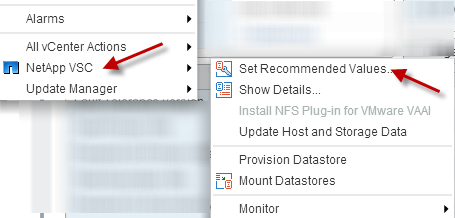
You could pick and choose which of these components to install as you see fit, but ideally you would want to deploy all three to take advantage of these enhancements and integration. The VSC software is installed on a server and associated with a specific vCenter. The NFS plug-in for VMware VAAI is installed on each VMware host and the VASA provider is deployed as a virtual appliance. It is important to point out that VSC  can also be utilized to set NetApp’s recommended values on ESXi hosts for better performance.


VSC_Logo

VSC_HostOptions

 VSC ESXi Host Options


VSC_VM_Options

VSC VM Options


Storage Virtualization: Yep, NetApp

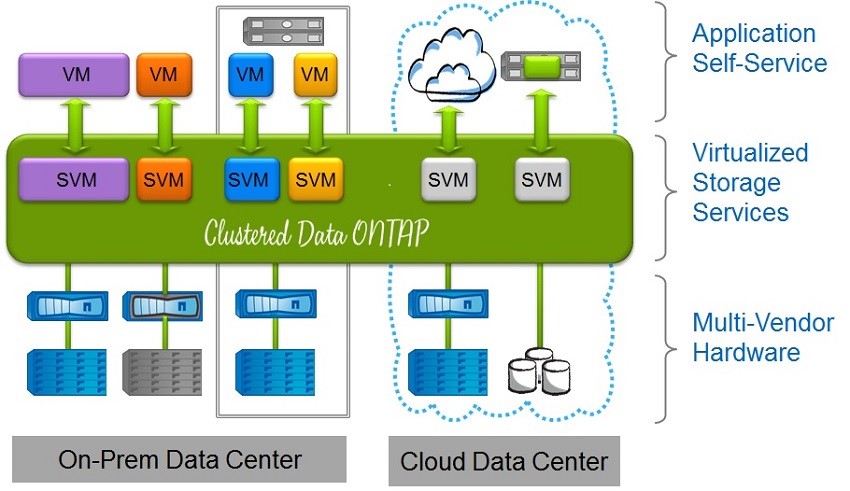
Just as VMware has been the pioneer for server virtualization, NetApp seems to be the virtualization player to beat in the realm of storage at this moment. Although NetApp’s ONTAP Cluster Mode (C-Mode) is not a new release, it is taking some of the legacy, 7-mode users some time to not only understand, but also implement C-Mode given its complexity compared to 7-mode. But an easy way to think of C-Mode, is to find the similarities with VMware’s vSphere.

Cluster mode breaks apart the physical aspect of the storage into a virtualized setup where several virtual storage environments can be created to segregate the diverse logical configurations. C-Mode can be a great use case for a public cloud service provider where the segregation of storage virtual machines is necessary; but let’s keep in mind, that this kind of segregation can also be heavily utilized within a private environment for many use cases.

Having recently achieved a master’s degree in Cyber-security and Information Assurance (CIA), I learned a few things about securing not only public environments, but also making sure we are internally secure. Your company is only as strong as its weakest link. After all, a great number of the attacks are generated internally by users with lack of knowledge or even malicious users. Through storage virtualization and the segregation of storage virtual machines, we can achieve not only better security but also better management through the use of policies.

NetApp_Stor_Virt


This virtualized storage environment allows for a more direct relationship with virtualized server environments such as VMware, where more granular control is needed. In my humble opinion, NetApp C-Mode and VMware vSphere are not that much different from each other. As I was preparing for my NCDA certification for NetApp (C- Mode), I couldn’t help but notice the similarities in their architectures. C-Mode acts as the Hypervisor, or in this case vSphere, and both platforms have virtual machines that act as independent identities. Such identities have their own personalities such as IP addresses, login information, mappings to a physical underlying network, etc.

While VMware uses servers for the physical platform, NetApp C-Mode uses their hardware and data ONTAP software to deliver storage virtualization; that once joined with VMware, become an extremely powerful solution for businesses of all sizes. Clearly, I am drinking the NetApp cool-aid, but I believe their technology in addition to VMware’s products make up for great SMB, and enterprise solutions. The two companies provide even better integrations and solutions through the use of VASA, VAAI, VVols, VSC, etc. More on them soon…


NetApp UTA2 Config

NetApp UTA2 ports are likely to be set up as FC ports out of the box. At least that has been my experience. That is perfectly fine if you plan to use those ports as Fiber Channel ports. In the event that you would like to use those ports as 10GbE ports, you will need to change the mode of the ports. This configuration should be done through the CLI.

In order to convert UTA2 or CNA ports to 10GbE, the following steps will need to be done.

  1. Check current configuration
  2. Disable the adapters
  3. Change the mode of the adapters
  4. Enable the adapters
  5. Reboot Cluster node

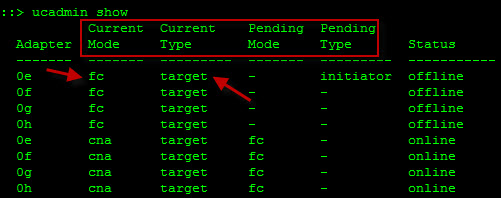
Check current configuration by using the “ucadmin show” command. This command will show the status, current and pending state, as well as current and pending type of the UTA2 ports.

NetApp_UcadminShow


Disabling the adapter depends on the current type of the adapter

IF> type=target THEN> run this… “fcp adapter modify -node <filer_node_name> -adapter 0e -state down

IF> type=initiator THEN> run this… “storage disable adapter <adapter_name>” this is a 7-mode command so you will need to run “system node run -node <node_name> -command <storage command>” or “system node run <node_name> and THEN run the command. So many options…


Change the adapter’s mode by using the command “ucadmin modify -node <node_name> -adapter <adapter_name> -mode cna

NetApp_ucadmin_modify

Once you have changed all the adapters’ modes. Enable the adapters and repeat on the other node.

Commands:

fcp adapter modify -node <node_name01> -adapter 0e -state up
fcp adapter modify -node <node_name01> -adapter 0f -state up
fcp adapter modify -node <node_name01> -adapter 0g -state up
fcp adapter modify -node <node_name01> -adapter 0h -state up


Reboot one filer at a time during non-production hours, of course. (system node reboot <node_name>)


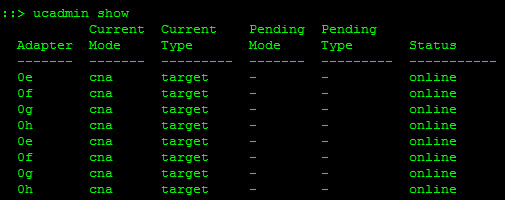
Run “ucadmin show” one more time to verify all looks good.

NetApp_UcadminShow_done

NetApp 7-Mode to Clustered Mode

I recently came across a new installation of NetApp Filers and discovered that they were shipped in 7-Mode instead of the requested Clustered Mode. The problem was that most of the documentation I found was pointing to old versions of ONTAP. Since new Filers are shipped with the newest versions of ONTAP (Thanks NetApp!), I figured it would be nice to document the procedure for the switch from 7-Mode to Clustered Mode.

The first step is to setup the pre-boot environment variables. In order to be able to do this, you will need to boot into loader prompt.

  1. Boot NetApp
  2. Press Ctrl-C when prompted to halt boot process
  3. This will take you to the loader prompt. If not, you missed your chance and will have to reboot again
  4. In Loader Prompt type:
    1. set-defaults
    2. setenv bootarg.init.boot_clustered true
    3. boot_ontap
  5. These commands will set clustered-mode as the default mode


Now that we have setup clustered-mode as the default, the Filer will boot up in clustered mode, but we are not done yet. You will then need to boot up into the boot menu and initialize your drives. BE CAREFUL, as this will erase all your data. So this walk-through applies if you are working on a new filer or re-purposing a filer from 7-mode to clustered mode. If you have any data that needs to be saved, or this is a production environment, do not follow these steps. Call Support.

Booting up to the Boot Menu:

  1. If you are setting the default parameters from the steps above, wait for the filer to reboot
  2. If not reboot the Filer
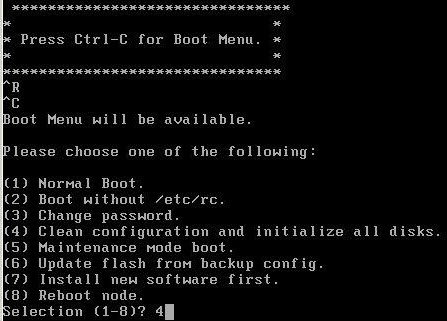
  3. As the Filer is rebooting, wait for the prompt to enter Boot Menu and hit Crtl-C to enter the menu.
  4. From this menu select option 4 (Clean configuration and initialize all disks)
    1. REMEMBER THAT THIS STEP WILL ERASE ALL YOUR DATA, INCLUDING SETTINGS SUCH AS IPs, DNS, etc.)

NetApp_BootMenu

  1. The Filer will reboot and start initializing the disks.
    1. This may take quite some time depending on the amount of drives installed.

After all disks have been initialized, the setup script will prompt for input in order to setup the “new” node.

If you have more the one node, repeat all the steps on the other node(s).


Use Cases: New Configurations. Re-purposing older controllers from 7-mode to Clustered mode.

DTv6

Not your next Internet protocol…

For those of us that like to test our knowledge with certifications, I got good news (or bad news, depending on how you look at it). VMware has released a new End User Computing certification for VMware Horizon View. This certification will validate your skills and experience with Horizon View.

The previous version (VCP5-DT), has not been deprecated as of now.

More information on VCP6-DT as well as blueprint info can be found here.

VCP6-DT